If your hair looks polished in the salon chair but expands the moment Johor Bahru humidity hits, the question is usually not whether you need a smoothing service. It is rebonding vs keratin treatment – and which one actually suits your texture, styling habits, and tolerance for maintenance.
These two services are often grouped together because both reduce frizz and make hair look smoother. But they do not work in the same way, and they do not create the same result. One changes the hair’s structure more permanently. The other coats and conditions the hair to soften, smooth, and relax the surface. That difference matters if you care about long-term wearability, natural movement, or how your hair will behave on ordinary mornings.
Rebonding vs Keratin Treatment: The Core Difference
Rebonding is a chemical straightening service that breaks and restructures the hair bonds. The goal is a straighter, flatter, more uniformly sleek finish. Once treated, the rebonded part of the hair stays straight until it grows out, which is why touch-ups are usually focused on new growth.
Keratin treatment works differently. It does not fully rebuild the hair into a permanently straight shape. Instead, it infuses the hair with smoothing and conditioning ingredients that help reduce frizz, improve shine, and make the hair easier to manage. Depending on the formula and the hair type, the result can range from softly polished to noticeably straighter, but it usually keeps more natural bend and movement than rebonding.
If you want a clear mental shortcut, think of rebonding as a shape-changing service and keratin as a texture-refining service.
Who Rebonding Suits Best
Rebonding is often the better fit for people with very wavy, bulky, or highly frizz-prone hair who want a consistently straight look with minimal daily styling. If your goal is that sleek, controlled finish from roots to ends, rebonding can be effective in a way that lighter smoothing services cannot always match.
It can also suit clients who are very clear about wanting straight hair rather than softer manageability. Some people do not want to work with their natural wave at all. They want to wake up, brush through, and see a straight silhouette. In that case, rebonding tends to align better with the expectation.
That said, rebonding is not automatically the best option just because your hair is frizzy. Hair density, previous bleach history, scalp sensitivity, and daily heat habits all matter. On fragile, overprocessed, or unevenly damaged hair, a strong restructuring service may create too much stress. Precision in consultation is what keeps the result beautiful rather than brittle.
Who Keratin Treatment Suits Best
Keratin treatment is often the more flexible choice for clients who want smoother hair but do not want it to look too flat or rigid. It is especially appealing if you like natural-looking movement, soft volume, or Korean-inspired styling where the hair still needs shape around the face.
This service can work well for hair that is puffy, dull, or hard to control in humid weather but not necessarily in need of full straightening. It is also a common choice for clients who blow-dry often and want styling to take less time. The hair usually becomes easier to detangle, shinier, and more cooperative.
For people who color their hair regularly or prefer a more touchable finish, keratin may feel like the more balanced option. It offers improvement without committing the hair to a very straight structure. That balance is why many clients with trend-aware, everyday styling goals gravitate toward it.
The Finish: Sleek Straight vs Soft Smooth
The most visible difference between rebonding and keratin treatment is the final look.
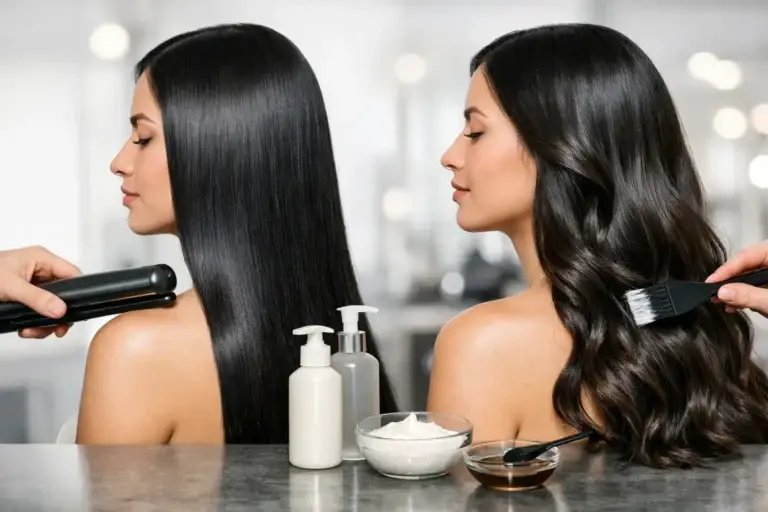
Rebonding tends to produce a sharper straight finish. Hair lies flatter, reflects light strongly, and appears more uniform from mid-length to ends. On the right hair type, this can look elegant and refined. On the wrong hair type or with the wrong haircut, it can sometimes feel too flat, especially if the client actually needs movement around the face.
Keratin treatment usually gives a softer result. Hair still looks neater and glossier, but it keeps more body. Instead of making the hair look fully transformed into straight hair, it makes the existing texture look calmer and more polished. For many clients, that is the difference between salon-styled beauty and hair that still feels natural in daily life.
This is where face shape, haircut design, and personal style matter. A person who wears sleek center-parted hair may love rebonding. Someone who prefers Korean layers, curtain framing, C-curls, or airy movement may find keratin more compatible.
Maintenance and Grow-Out
Rebonding asks for more commitment over time. Because the treated hair stays straight while new growth comes in with your natural texture, there can be a visible difference at the roots after some months. If your hair grows quickly or your natural texture is strong, the contrast becomes obvious sooner.
Keratin treatment fades more gradually. The hair slowly returns closer to its natural texture as the treatment washes out. That makes grow-out softer and less dramatic. For clients who like flexibility or are not sure they want a long-term straightening commitment, this can feel more comfortable.
Home care matters for both, but especially if you want the finish to stay clean and smooth. Sulfate-free formulas, moisture support, and controlled heat styling can help maintain results. With rebonding, careful handling is essential because chemically restructured hair can become dry if neglected. With keratin, the main goal is extending the smoothing effect and keeping the cuticle calm.
Which Service Is Gentler on Hair?
This is where honesty matters. Neither service should be treated casually, and neither is universally “safe” or “damaging” without context. Hair history changes everything.
Rebonding is generally the more intensive process because it changes the internal bonds of the hair. On healthy, suitable hair and in experienced hands, the result can still be smooth and beautiful. But it demands accurate timing, proper product choice, and realistic expectations.
Keratin treatment is often seen as the gentler option because it focuses more on smoothing and coating than full restructuring. Even so, not every keratin formula is equal, and not every head of hair needs the same level of heat or product strength. A premium salon should assess elasticity, porosity, chemical history, and scalp condition before recommending either one.
If your hair has been heavily bleached, repeatedly colored, or is already snapping at the ends, the smartest service may be neither of these immediately. Sometimes repair, trimming, and a phased treatment plan are the more professional answer.
Rebonding vs Keratin Treatment in Humid Weather
Humidity is exactly why so many clients ask about these services. In tropical weather, even healthy hair can swell, separate, and lose shape quickly.
Rebonding usually gives stronger resistance against expansion because the hair has been structurally straightened. If your main frustration is aggressive frizz and unmanageable width, rebonding may offer stronger control.
Keratin treatment still helps significantly with humidity, but in a more moderate way. It reduces puffiness and surface frizz while allowing some natural texture to remain. For many people, that is enough. They do not need pin-straight hair. They just want hair that stays polished from morning to evening without turning fluffy.
The best choice depends on what you mean by “manageable.” For some, manageable means perfectly straight. For others, it means soft, smooth, and easy to style in 10 minutes.
What a Good Consultation Should Ask
A proper consultation should go beyond “Do you want straight or smooth?” It should ask how often you heat-style, whether your hair is colored or bleached, how much movement you like in your cut, whether your scalp is sensitive, and how much maintenance you are realistically willing to do.
This is especially important for clients who commute between Singapore and Johor Bahru, or anyone whose schedule demands hair that performs well with little daily effort. The right service is not the one that looks dramatic on day one. It is the one that still feels right three months later.
At Somi Hair Korean Salon JB, this kind of decision is best made through a close look at your hair condition, design goals, and daily routine rather than a one-size-fits-all recommendation. That is how smoothing services stay elegant, comfortable, and practical after the appointment – not just during it.
So Which One Should You Choose?
Choose rebonding if you want a more permanent straight result, your hair can handle a stronger chemical process, and you prefer a sleek look with minimal daily reshaping.
Choose keratin treatment if you want frizz reduction, shine, softer manageability, and a more natural finish with movement still intact.
If you sit somewhere in the middle, that is normal. Many clients do. The best answer is often not the trendiest service but the one that respects your hair’s limits while matching how you actually live with your hair every day.
Good hair should not only look smooth under salon lighting. It should still feel like you on a rushed weekday, in humid weather, with no filter and no extra effort.